








Clean Ultrasound Probe, Safe Patient: Improving Infection Control in Medical Ultrasound
Medical ultrasound has become indispensable across cardiology, obstetrics and gynecology, emergency medicine, anesthesiology, critical care, surgery, vascular access, and interventional practice. Its portability, real-time imaging capability, and lack of ionizing radiation have expanded ultrasound use far beyond traditional imaging departments.
This expansion has also created an important infection-prevention challenge. Ultrasound transducers, cables, controls, gel containers, and associated accessories may move rapidly between patients and clinical environments. Depending on the procedure, a transducer may contact intact skin, non-intact skin, mucous membranes, blood, body fluids, or normally sterile tissue.
A safe reprocessing program must therefore do more than instruct staff to wipe the probe. It should combine risk-based classification, validated cleaning and disinfection methods, compatible products, appropriate barriers and coupling gel, environmental controls, staff competency, documentation, and continuous quality improvement.
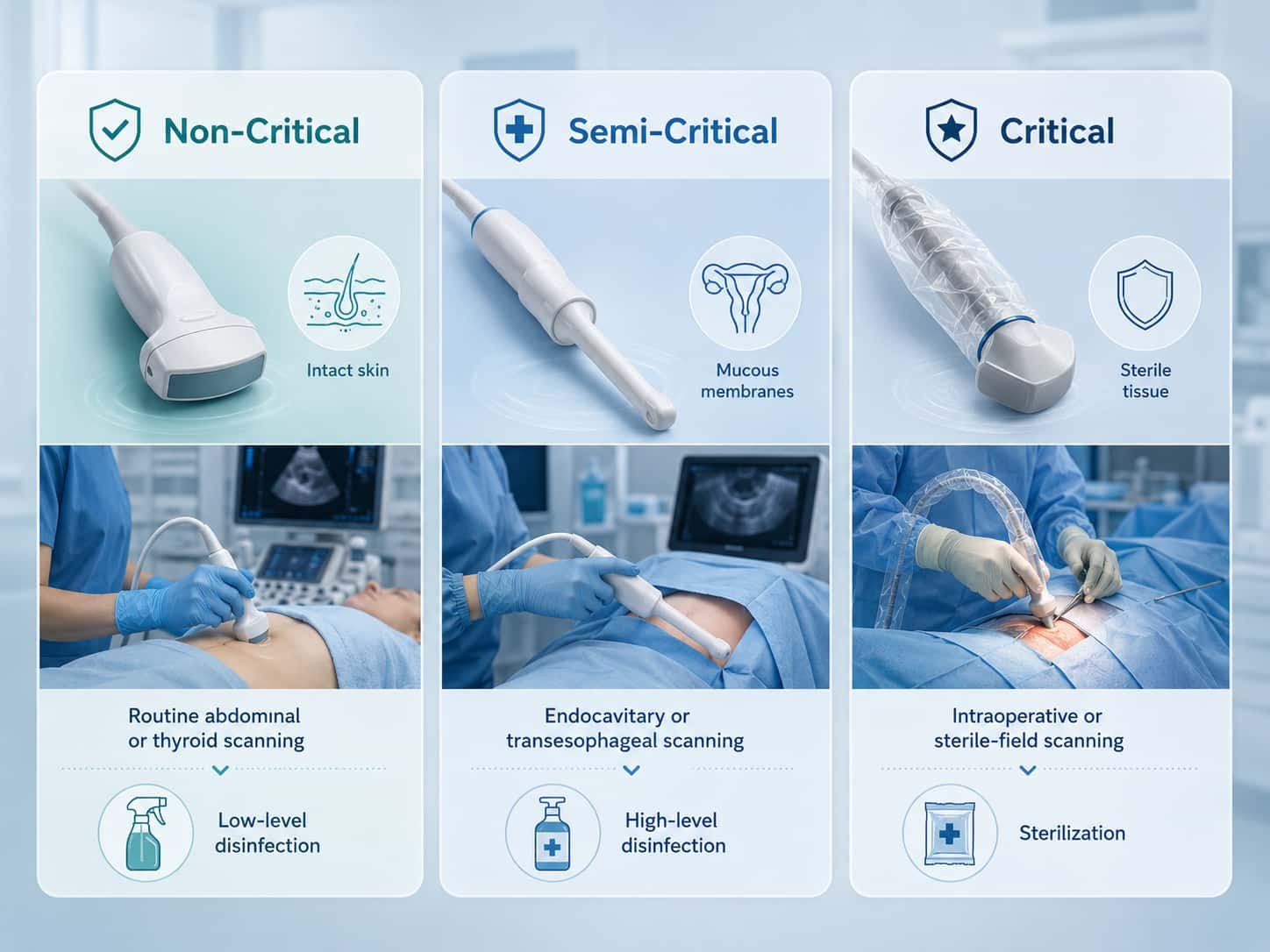
International infection-prevention guidance commonly applies the Spaulding classification, which divides reusable medical devices into three groups according to the tissue they contact and the consequences of microbial contamination.
The classification should be based on the transducer’s actual clinical use, not merely its product name. The same external transducer may be non-critical during routine abdominal imaging but may require additional controls when used near an open wound, during an invasive procedure, or within a sterile field.
Using an unapproved chemical or immersing a non-immersible component may damage the acoustic lens, housing, adhesives, cable, connector, electrical insulation, or image quality.
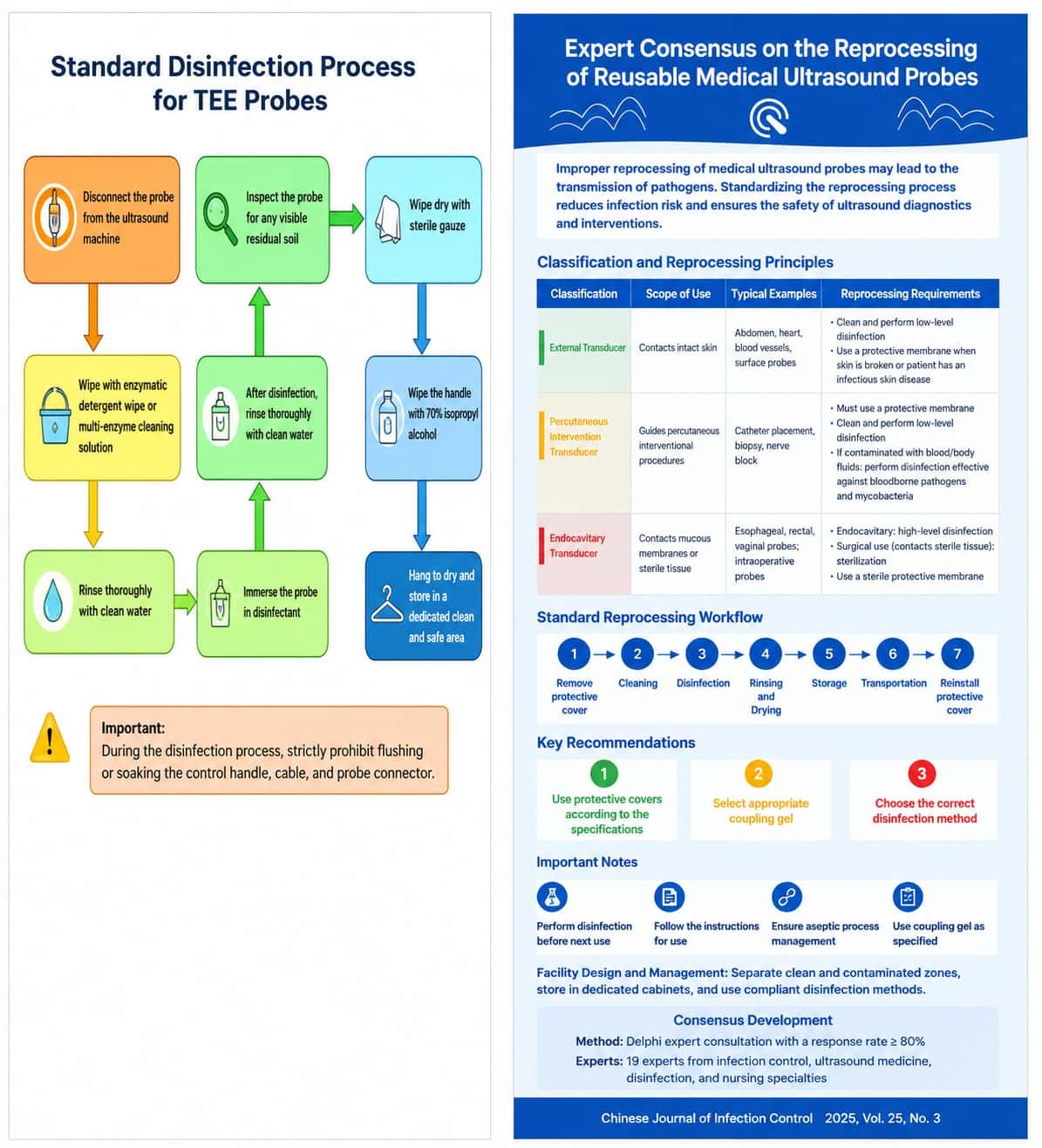
Transducers used for routine abdominal, thyroid, breast, musculoskeletal, vascular, cardiac, or obstetric imaging on clean, intact skin are generally classified as non-critical devices.
- Remove all visible coupling gel, skin debris, and organic material.
- Clean the transducer using a manufacturer-approved method.
- Apply an approved low-level disinfectant for the specified contact time.
- Clean high-touch components such as the cable, holder, keyboard, touchscreen, controls, and examination surface.
Cleaning must precede disinfection whenever visible soil is present because residual organic material can reduce disinfectant effectiveness.
Examples include vascular access, regional anesthesia, biopsy, aspiration, drainage, thoracentesis, paracentesis, lumbar puncture, and catheter placement.
International recommendations are not completely uniform in this area. Some professional guidance permits cleaning and low-level disinfection for external transducers used with an appropriate single-use cover and aseptic technique. Other guidance takes a more conservative approach when the transducer is used within a sterile field or near a puncture site.
- The tissue contacted and the type of procedure
- The possibility of cover failure
- Whether the transducer enters the sterile field
- The manufacturer’s validated processing methods
- National regulations and professional guidance
- The patient population and consequences of contamination
For procedures requiring surgical asepsis, the transducer should be enclosed in a sterile, single-use cover. Sterile, single-use ultrasound gel should be used wherever gel may enter the sterile field, puncture site, vascular system, or normally sterile tissue.
Transvaginal, transrectal, and transesophageal transducers contact mucous membranes and are classified as semi-critical devices.
- Use a suitable single-use protective cover whenever feasible.
- Perform thorough cleaning after every patient.
- Complete high-level disinfection after every use.
- Rinse, dry, inspect, and store the device according to validated instructions.
A protective cover does not eliminate the need for high-level disinfection. Covers may tear, develop microscopic defects, or become contaminated during removal.
A transducer or reusable accessory that directly enters normally sterile tissue, a sterile body cavity, or the vascular system is a critical device. Sterilization is the preferred requirement whenever the device design and manufacturer’s instructions permit it.
A sterile cover provides an additional barrier but should not automatically be treated as a substitute for sterilization. Cover integrity, contamination during removal, and direct tissue contact must all be considered.
Reusable needle guides, biopsy brackets, puncture attachments, and similar accessories should be classified independently. Accessories that penetrate tissue or guide a needle into a sterile site generally require sterilization.
Transducer covers reduce contamination but do not eliminate it. Cover selection should reflect the procedure, tissue contacted, required level of asepsis, and patient-specific risk.
- A non-sterile, single-use cover may be suitable for selected low-risk applications.
- A sterile cover is required when maintaining a sterile field or performing a sterile procedure.
- The cover should be compatible with the transducer and long enough to protect the relevant cable section.
- Latex-containing covers should be identified and avoided when allergy is known or suspected.
- The transducer must still undergo the required cleaning, disinfection, or sterilization process after cover removal.
Coupling gel is not inherently sterile. Contaminated ultrasound gel has been associated with healthcare outbreaks and bloodstream contamination, particularly when non-sterile products are used during invasive procedures.
- Percutaneous and vascular-access procedures
- Procedures involving normally sterile tissue
- Examinations involving non-intact skin
- Use near fresh surgical wounds
- Procedures performed within a sterile field
- Any situation in which gel could enter a puncture site or sterile body area
- Never refill or top off a partially used bottle.
- Prevent the dispensing tip from touching the patient, transducer, hands, or surfaces.
- Close the container when it is not in use.
- Store the bottle upright in a clean holder.
- Discard the product whenever contamination is suspected.
- Use only a manufacturer-approved dry warming system; avoid communal water baths.
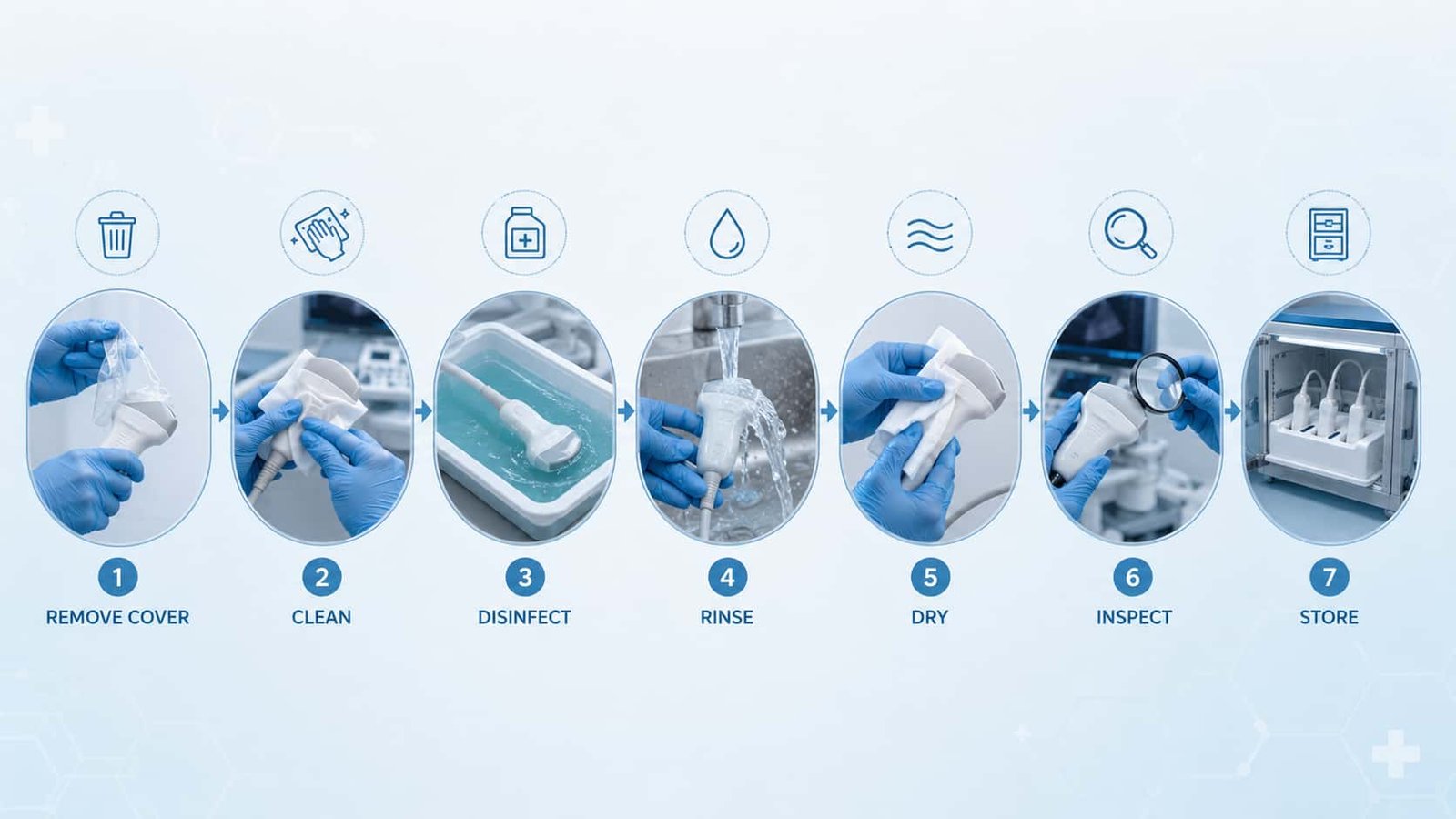
Remove the protective cover carefully, dispose of single-use accessories, remove heavy gel and visible contamination before it dries, and place the used transducer in a designated contaminated container when transport is required.
Use only manufacturer-approved detergents, wipes, brushes, and water quality. Clean the acoustic lens, handle, grooves, seams, joints, cable, and other exposed surfaces. Repeat cleaning whenever visible contamination remains.
Remove detergent residues according to validated instructions. Dry the device before chemical high-level disinfection when residual water could dilute the disinfectant.
Match the process to the device classification and actual use. Confirm device compatibility, correct concentration, complete surface contact, required exposure time, solution reuse life, ventilation requirements, and documentation obligations.
Use the water quality and rinsing method specified by the disinfectant label, transducer manufacturer, local regulation, and intended clinical use. Sterile water is not automatically required for every device or application.
Dry the transducer thoroughly with a clean, lint-free method. Inspect the lens, housing, seams, cable, connector, strain relief, and attachment areas for cracks, peeling, swelling, discoloration, fluid ingress, or other damage.
Store processed transducers in a dry, protected, ventilated environment that prevents recontamination and physical damage. Clean and contaminated devices must be transported separately in closed, clearly identified containers.
Reprocessing areas should support one-way movement from contaminated to clean activities. The physical environment should reduce the possibility of processed devices being re-exposed to contaminated hands, surfaces, equipment, or aerosols.
Receiving, cover removal, initial handling, and cleaning of used transducers.
High-level disinfection, sterilization, rinsing, chemical monitoring, and cycle documentation.
Drying, inspection, status identification, protected storage, and preparation for reuse.
The ultrasound console should also be included in environmental cleaning policies. Keyboards, touchscreens, handles, cables, transducer holders, gel warmers, examination tables, and mobile-cart surfaces are frequently touched and may contribute to cross-contamination.
A sustainable reprocessing program requires institutional governance rather than reliance on individual practice habits. Written policies should clearly define responsibilities, approved products, required processing levels, chemical controls, transport arrangements, storage requirements, and procedures for managing failures.
- Risk classification and procedure-specific requirements
- Hand hygiene and personal protective equipment
- Safe removal of protective covers
- Cleaning and disinfectant contact time
- Chemical handling and ventilation
- Rinsing, drying, inspection, and storage
- Recognition of device damage
- Documentation and management of processing failures
- Staff competency completion rates
- Compliance with required disinfectant contact times
- High-level disinfection and sterilization cycle completion
- Correct availability and use of sterile gel
- Storage and transport audit findings
- Frequency of incomplete or undocumented cycles
- Transducer damage and repair rates
- Occupational exposure and infection-control incidents
Record every transducer, cable, needle guide, biopsy attachment, transport container, storage cabinet, and reprocessing system, including model numbers and current instructions for use.
Document where and how each transducer is used, including routine imaging, isolation rooms, wounds, vascular access, biopsy, endocavitary examinations, surgery, and sterile procedures.
Classify each application as non-critical, semi-critical, or critical. Where guidance differs, follow the most stringent applicable legal, regulatory, and manufacturer requirement.
Confirm that products, equipment, facilities, and transport systems are compatible with the devices and capable of achieving the required processing level.
Use procedure-specific checklists, supervised practice, and direct observation rather than education alone.
Review processing failures, compliance data, damaged equipment, occupational exposures, chemical safety events, and infection-control incidents. Update policies whenever devices, procedures, regulations, or manufacturer instructions change.
Ultrasound transducer reprocessing should be treated as a structured medical-device safety system rather than a simple cleaning task. The safest approach combines Spaulding risk classification, the manufacturer’s validated processing instructions, applicable national regulations, professional guidance, and a facility-specific infection-prevention assessment.
External transducers used on intact skin generally require cleaning and low-level disinfection. Endocavitary and transesophageal transducers require cleaning and high-level disinfection even when protective covers are used. Devices that directly enter sterile tissue should be sterilized whenever technically feasible.
Effective infection prevention ultimately depends on consistent cleaning, correct disinfectant contact time, device compatibility, safe gel practices, appropriate facility design, staff competency, traceability, and prompt management of processing failures.
- American Institute of Ultrasound in Medicine.
Guidelines for Cleaning and Preparing External- and Internal-Use Ultrasound Transducers and Equipment Between Patients, as Well as Safe Handling and Use of Ultrasound Coupling Gel.
https://www.aium.org/resources/official-statements/view/guidelines-for-cleaning-and-preparing-external–and-internal-use-ultrasound-transducers-and-equipment-between-patients-as-well-as-safe-handling-and-use-of-ultrasound-coupling-gel
- US Centers for Disease Control and Prevention.
Guideline for Disinfection and Sterilization in Healthcare Facilities: Summary Recommendations.
https://www.cdc.gov/infection-control/hcp/disinfection-sterilization/summary-recommendations.html
- US Centers for Disease Control and Prevention.
Healthcare Equipment: Cleaning, Disinfection, and Sterilization.
https://www.cdc.gov/infection-control/hcp/disinfection-sterilization/healthcare-equipment.html
- US Centers for Disease Control and Prevention.
Use Only Sterile Ultrasound Gel for Percutaneous Procedures.
https://www.cdc.gov/healthcare-associated-infections/bulletins/outbreak-ultrasound-gel.html
- International Organization for Standardization.
ISO 17664-1:2021, Processing of Health Care Products: Information for Processing Critical and Semi-Critical Medical Devices.
https://www.iso.org/standard/81720.html
- International Organization for Standardization.
ISO 17664-2:2021, Processing Information for Non-Critical Medical Devices.
https://www.iso.org/standard/74152.html
- US Food and Drug Administration.
Reprocessing Medical Devices in Health Care Settings: Validation Methods and Labeling.
https://www.fda.gov/media/80265/download
- US Food and Drug Administration.
FDA-Cleared Sterilants and High-Level Disinfectants with General Claims for Processing Reusable Medical Devices.
https://www.fda.gov/medical-devices/reprocessing-reusable-medical-devices-information-manufacturers/fda-cleared-sterilants-and-high-level-disinfectants-general-claims-processing-reusable-medical-and
- European Federation of Societies for Ultrasound in Medicine and Biology.
Best Practice Recommendations for Cleaning and Disinfection of Ultrasound Transducers.
https://efsumb.org/wp-content/uploads/2021/12/2022-probe_cleaning_recommendation.pdf
- Australasian Society for Ultrasound in Medicine and Australasian College for Infection Prevention and Control.
Guidelines for Reprocessing Ultrasound Transducers.
https://www.asum.com.au/wp-content/uploads/2026/03/Guidelines-for-Reprocessing-Ultrasound-Transducers-2026-POSTER.pdf